Want to be Healthier but feeling Overwhelmed? Start Here

First, can I just say — the fact that you're here, reading this, means something. It means some part of you is ready to feel better. And I want you to know that's enough. That small flicker of "I want something to change" is exactly the right place to begin.
I also want to say this gently but honestly: if you've been trying to figure out where to start and keep ending up more confused than when you began, that is not your fault.
The wellness world is loud and contradictory and often makes healthy living sound like a full-time job on top of the full-time job you already have. Green smoothies and 5am routines and 47-step protocols — it's a lot. Of course it's overwhelming.
But here's what I truly believe, and what I want to walk you through today: taking care of yourself does not have to be complicated. In fact, the most powerful things you can do for your health are also the most simple. They're not exciting. They aren't glamorous. And it won't make anyone go viral in the social media space.
But they work — quietly, steadily, and in ways that compound over time in the most beautiful way.
We're going to talk about four foundational areas: sleep, stress, nourishment, and movement. These are the things that, when they're even mostly tended to, make everything else feel more manageable. More possible. More like you again.
And here's my promise to you before we even start: you don't have to do all of this at once. You don't have to do most of it. You just have to find your one starting place — and I'm going
Why we're starting with foundations
I want to take a moment to explain why we're talking about these four things specifically, because I think it matters.
A lot of health advice assumes you're already in a decent place — sleeping okay, managing stress reasonably well, eating in a way that gives you energy — and then piles advanced strategies on top. And if your foundations aren't there yet, all of that advice just slides right off. Nothing sticks. And then you wonder what's wrong with you. Nothing is wrong with you. The advice was just starting in the wrong place.
Sleep, stress, nourishment, and movement are the foundation. They influence each other in the most beautiful, interconnected way — better sleep makes stress easier to manage, which makes nourishing yourself feel less fraught, which gives you more energy to move your body, which helps you sleep better. When one starts to improve, the others often follow. That's what we're building toward.
Not perfection. Not a complete transformation overnight. Just a little more ease. A little more energy. A little more of feeling like yourself.
1. Sleep: Let's give your body the rest it's been asking for
I want to start here because, in my experience, sleep is the area where so many women are quietly running a deficit — and also the one that tends to feel least urgent, because we've gotten so used to being tired.
Sweet friend, exhaustion is not a personality trait. It's not something you just push through forever. Your body is asking you for something — and that something is rest.
What's really happening when you're not sleeping enough
Sleep is one of the most biologically active things your body does. While you're asleep, your brain is doing a literal cleanse — clearing out waste products that accumulate throughout the day. Your cells are repairing. Your immune system is doing its deepest work. The hormones that regulate your hunger, your mood, and your stress response are being reset and recalibrated.
When sleep is regularly cut short, all of that gets interrupted. Your hunger hormones shift in ways that make you crave sugar and carbohydrates. Your cortisol — the stress hormone — rises even before anything stressful has happened. The part of your brain responsible for patience, perspective, and good decision-making gets foggy.
So if you've been feeling more reactive than usual, more hungry than you think you should be, more like you're just barely keeping it together — please don't be hard on yourself. Your body is working really hard with less than it needs. That's not weakness. That's just math.
A gentle note about "catching up" on sleep
A lot of us try to compensate during the week by sleeping in on weekends — and while that can take the edge off, it doesn't fully reverse the cumulative effects. What your body really craves is consistency, not recovery. A regular rhythm it can count on.
Where to start, gently
The single most impactful sleep habit is a consistent wake time. Not a perfect bedtime — just a consistent time to get up, even on weekends. This anchors your body's internal clock, which governs so much more than just sleep. Pick a time that actually works for your real life, not an aspirational one, and try to honor it for a couple of weeks. Your body will start naturally getting sleepy at the right time to support it.
Beyond that, a few things that make a real difference:
- Morning light. Getting outside within the first 30 minutes of waking — even on a cloudy day — sets your body's clock for the whole day and genuinely improves sleep quality that night. Even a few minutes on your porch with your coffee counts.
- A wind-down buffer. Your nervous system can't go from full speed to deep sleep without a transition. Even 20 minutes of genuinely quiet activity before bed — a book, gentle stretching, a warm bath — tells your body the day is ending. Scrolling your phone, as lovely as it is to zone out, keeps your brain activated in ways that delay sleep. This isn't about willpower; it's just about what your body responds to.
- A cool room. Your core body temperature needs to drop slightly to initiate deep sleep. A cooler bedroom — around 65–68°F — helps that happen naturally.
- About alcohol. I mention this with care, not judgment: while it can feel like it helps you wind down, alcohol disrupts the second half of your sleep cycle significantly. If you find yourself waking at 2 or 3am and struggling to fall back asleep, this is very often why.
Your one starting habit, if you're choosing sleep: Set a consistent wake time and honor it for two weeks. That's the whole assignment. Everything else can wait.
2. Stress: Your body isn't failing you — it's protecting you
I want to reframe something for you, because I think it can genuinely change how you relate to yourself.
Stress is not a sign that you can't handle your life. It is a biological protection system that evolved over thousands of years to keep you safe in moments of real danger. It's incredibly sophisticated. The problem isn't that you have it — it's that modern life gives it very little room to complete its cycle. The alarm goes off and then just... stays on. And that takes a toll.
What chronic stress does in your body
When your brain perceives a threat — and it cannot tell the difference between a predator and a passive-aggressive email; it responds to both — it releases cortisol and adrenaline. Your heart rate rises. Blood gets redirected away from digestion and toward your muscles. Your immune system quiets down. Your nervous system shifts into high alert.
In short bursts, this is useful. It's what helps you meet a deadline or respond quickly in a difficult moment. But when this state becomes your baseline — when there's always something, and the alarm never fully turns off — it starts to affect everything. Your digestion. Your hormones. Your immune system. Your sleep. Your mood. Your ability to feel joy.
This is why tending to stress isn't a luxury or something you do once you've handled everything else. It is foundational, and you deserve to treat it that way.
Something that changed how I think about stress
Researchers Emily and Amelia Nagoski introduced a concept I find really helpful: stress has a biological cycle that needs to be completed. The stressor going away — the email getting answered, the hard conversation ending, the deadline passing — doesn't actually complete the cycle. Your body still has all that physiological activation running, and it needs somewhere to go.
The most effective ways to complete the cycle are physical: movement, a good cry, deep laughter, a long hug, creative expression. This is why a walk after a hard day feels genuinely different from just sitting with a hard day. The movement isn't a distraction — it's finishing what the stress started. Your body is doing exactly what it needs to do.
Where to start, gently
- Build transitions into your day. Your nervous system needs a signal between contexts — a moment that says that chapter is closing, this one is beginning. A five-minute walk outside, making a cup of tea slowly and with intention, changing into comfortable clothes after work. These small rituals act as anchors. They give your system a moment to regulate before the next demand arrives.
- Learn one breathing practice. Box breathing — inhale for 4 counts, hold for 4, exhale for 4, hold for 4 — activates your parasympathetic nervous system, the part responsible for rest and calm. It works in a matter of minutes. Keep it in your back pocket for moments when you feel overwhelm rising.
- Notice what you're taking in. News, social media, group chats, the endless scroll — these are real inputs that your nervous system registers as stimulation and, often, threat. You don't have to eliminate them, but being intentional about when and how much you consume them is a form of self-care.
- Put words to what you're feeling. Research has found that naming an emotion — genuinely labeling it, even just to yourself — reduces the intensity of the stress response in the brain. "I'm feeling overwhelmed right now" is not just acknowledgment. It's regulation. It tells your nervous system that the thinking part of your brain is still present, still in charge.
- Rest is not the same as numbing. Scrolling, though it gives us a break from thinking, doesn't truly restore the nervous system. Real rest is quieter — being in nature, gentle movement, creative absorption, actual connection with another person. You deserve the kind of rest that actually fills you back up.
Your one starting habit, if you're choosing stress: Create one small transition ritual between your two most demanding moments of the day. Make it simple, sensory, and something you can actually look forward to.
3. Nourishment: What if we started with adding, instead of taking away?
I want to talk about this one with a lot of care, because for so many women, the relationship with food has been complicated by years of diet culture messaging. The constant noise about what's good and what's bad, what's allowed and what isn't, clean eating and cheat days and all the ways our choices get tied to our worth.
If any of that has left you feeling exhausted or confused or like you can't trust your own hunger — I see you. And I want to offer a different way in.
What if instead of starting with restriction, we started with addition? Instead of asking what you should stop eating, we asked: what does my body actually need to feel good? And then we simply started adding more of that.
What your body is genuinely asking for
At its most basic, your body needs enough food — enough total energy to run all the extraordinary things it does every single day without you even having to think about it. It needs protein to repair and maintain your cells and muscles. It needs fiber to support the gut microbiome that influences your mood, your immune system, and your hormones. It needs healthy fats for brain function and hormone production. It needs a wide variety of plants to get the micronutrients that make all of it possible.
Many women who feel chronically tired, foggy, or emotionally off are not eating terribly — they're just under-fueling. Not enough food overall. Not enough protein. Not enough variety. Running on coffee and willpower and then feeling confused about why they crash at 3pm and want to eat the entire kitchen.
Your hunger is not the enemy. It's information.
A word about your gut
The research on the gut microbiome over the last decade has been genuinely fascinating. The trillions of bacteria that live in your digestive tract have a profound influence on your mood, your immune function, your inflammation levels, and how you respond to stress. They are fed primarily by the variety of plant foods you eat — and the magic word there is variety. Not perfection. Not "clean eating." Diversity. Aiming for around 30 different plant foods per week — vegetables, fruits, legumes, whole grains, nuts, seeds, herbs, spices — is one of the most nourishing things you can do for your gut and, through it, for nearly everything else.
Where to start, gently
- Add protein to your breakfast. Many of us start the day with mostly carbohydrates — toast, cereal, fruit — which creates blood sugar fluctuations that ripple through the entire day as energy crashes and cravings. Adding a protein source to whatever you're already eating (eggs, Greek yogurt, cottage cheese, nut butter) creates a much more stable foundation. You don't have to change your whole breakfast. Just add something.
- Add one vegetable to one meal a day. Not every meal. One. Frozen vegetables are wonderful. A handful of spinach in a smoothie counts. A few cherry tomatoes on the side counts. Start with the lowest-friction version and build from there when it feels easy.
- Drink water before coffee. You wake up mildly dehydrated after hours without water, and coffee — as beloved as it is — is a diuretic. One glass of water first is a tiny habit with a surprisingly meaningful effect on morning energy and mental clarity.
- Please don't skip meals to be "good." I say this with so much gentleness: undereating puts your body into a stress response. Cortisol rises, your metabolism slows, and you're more likely to feel desperately hungry later and eat in a way that doesn't feel good. Regular meals that actually satisfy you aren't indulgent. They're stabilizing.
- Be kind to yourself about the big picture. One meal, one day, one difficult week does not define your health. What you eat consistently over months and years is what matters. A piece of birthday cake is not a setback. It's Tuesday. The all-or-nothing thinking that diet culture instills — the sense that one "bad" meal means you've failed and might as well give up — keeps so many women stuck in a cycle that has nothing to do with actual nourishment. You deserve to be free of that.
Your one starting habit, if you're choosing nourishment: Add a protein source to your breakfast every day for two weeks. Just notice how you feel by mid-morning. Let your body show you.
4. Movement: Permission to start exactly where you are
Let's talk about movement — and I want to start by gently setting aside whatever image the word "exercise" brings up for you, because I think for a lot of us, it comes with a lot of baggage. Old gym memories. Routines that felt punishing. The sense that it only really counts if it's hard and scheduled and you're sweating through something you dread.
What I want to offer instead is a much wider, much kinder definition: movement is simply your body getting to be in motion. Walking, stretching, dancing in your kitchen, gardening, swimming, a leisurely bike ride, climbing stairs, chasing children around a park. All of it counts. All of it matters. None of it requires a gym membership or a specific outfit or arriving somewhere at a particular time.
What movement does that truly nothing else can replicate
I want to share this not to make you feel guilty but because I find it genuinely encouraging: movement is one of the most potent things known for mood and mental health. Multiple studies have found it comparable to medication for mild to moderate depression and anxiety — and that's not a small thing. It also improves sleep, reduces inflammation, supports bone density, stabilizes blood sugar, and increases something called BDNF — a protein that supports brain health, learning, and memory. It is one of the most generous things you can do for yourself.
And the dose required for these benefits is genuinely, beautifully accessible. Around 150 minutes of moderate movement per week — the equivalent of a 20-30 minute walk most days — is associated with significant reductions in risk for cardiovascular disease, diabetes, and so much more. You do not need to be an athlete. You just need to move your body, regularly, in ways that feel sustainable.
A gentle word about strength training
I mention this specifically for women because it doesn't always come up in the conversation: resistance training is one of the most underused health tools available to us. It preserves and builds muscle mass — which becomes increasingly important after our thirties. It supports bone density. It improves balance, energy, and the way you feel in your body day to day. You do not need a gym for this. Bodyweight exercises at home — squats, lunges, push-ups — done consistently twice a week make a real, meaningful difference.
Finding movement that feels like care, not punishment
Here's the thing I really want you to hear: the most effective movement for your health is whatever you will actually do. And what you'll actually do consistently is almost always something that feels bearable, or better yet, something you genuinely enjoy.
If the gym makes you dread the day before you even get there, please stop going to the gym. Walk instead. Try a dance class. Go swimming. Do yoga in your living room in pajamas. Find the version that feels the least like obligation, and start there. The goal, over time, is to build a relationship with your body that is rooted in care and capability — not in earning or punishing or measuring up to something.
Where to start, gently
- Walk after at least one meal a day. A gentle 10-15 minute walk after eating — especially after dinner — has lovely effects on blood sugar, digestion, and sleep. It's also simply pleasant in a way that most "workouts" aren't. This is where I'd start if I were starting over.
- Add two short strength sessions per week. Twenty minutes of simple bodyweight exercises done twice a week is genuinely enough to begin building and preserving muscle. There are free beginner videos all over YouTube — find one that feels approachable, not intimidating.
- Break up sitting throughout the day. Standing up and moving for a few minutes every hour or so has measurable metabolic benefits that are separate from your "exercise" time. A walk to the kitchen, a few stretches, a short loop around the block — these small interruptions add up.
- Make it something you can look forward to. A podcast you save for walks. A playlist that makes you feel alive. A route you love. A friend who'll walk with you and talk the whole time. These aren't tricks. They're what turn a habit into something sustainable.
Your one starting habit, if you're choosing movement: Take a 15-minute walk after dinner every evening for two weeks. Just that. Let it be easy.
So, where do you start?
Take a breath, and look back over these four areas. Sleep. Stress. Nourishment. Movement.
Ask yourself, with kindness: which one is asking for my attention most right now? Not which one is most important in theory. Not which one you feel like you "should" prioritize. Which one, if you gently tended to it this week, would make the biggest difference in how you feel?
Start there. Only there.
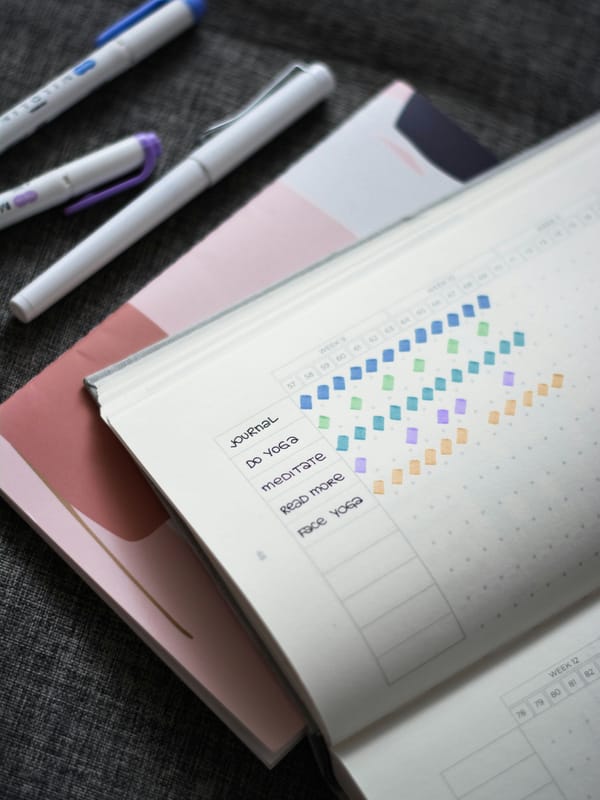
Pick one habit from that section — the softest, most manageable version of it you can imagine. Write it down somewhere you'll actually see it. And give it two weeks before you even think about adding anything else.
I know it might feel too small. I know part of you wants to do all of it, right now, and feel better by next week. I understand that completely. But here's what I've seen: the women who make lasting, real changes are almost never the ones who transformed everything at once. They're the ones who chose something small, tended to it quietly until it became second nature, and then gently added the next thing. A few months later, their whole life looks different — and it happened so gradually that it almost snuck up on them.
That's the kind of change that actually stays.
A gentle reminder about imperfect weeks
There will be weeks — many of them — where sleep goes sideways, stress wins, nourishment falls apart, and the walk doesn't happen. That is not failure. That is life. A full, real, human life.
The practice isn't consistency. The practice is returning. Every time you have a hard week and quietly come back to your one small habit on Monday morning, you are doing the most important thing. You are showing yourself that you haven't given up. That you're still in this. That caring for yourself is something you keep choosing, even imperfectly, even slowly.
That returning is everything.
You don't have to travel the whole distance today. You just have to take the next step — and you already have, by being here.